Showing posts with label Mazda. Show all posts

Saturday, June 4, 2011

2011 MAZDA 6 Extream Concept Cars

 2011 MAZDA 6 Reviews Specs Prices and Pictures

During its rigorous development, some 400 Mazda engineers subjected crucial MAZDA 6 components to testing that simulated 10 years of extreme use. Then, to further prove its reliability, they drove a fleet of MAZDA 6 test cars for a total of more than one million miles. In fact, by the time you see a MAZDA 6, it will have survived a demanding gauntlet of quality control standards that are among the strictest in the industry. Hundreds upon hundreds of individual inspections are conducted by an army of Mazda inspectors. Each one empowered to reject any part, fit, detail or component that fails to measure up. Because from the smallest interior switch to the virtually flawless exterior finish, quality is an obsession at Mazda. Which is why, as you lose yourself in the pure driving fun of a MAZDA 6, you can be confident that Mazda durability and attention to detail will be there for you. Today. Tomorrow. And many years down the road.

2011 MAZDA 6

Wind turbulence and drag are the enemies of performance. They compromise responsiveness and stability. Undermine fuel economy. And disrupt a quiet ride. We were determined to defeat their fun-spoiling ways when we designed the 2011 MAZDA 6. We subjected it to 360 degrees of wind tunnel testing. Applying what we learned front to back, side to side, top to bottom. We even added an innovative system of underbody shields and deflectors to manage airflow. The well-honed results: A performance-enhancing, fuel-friendly coefficient of drag (0.27 Cd) that’s lower than Accord or Camry. And sophisticated styling that’s beautiful from every angle.

Purposefully sculpted outside mirrors and sleek A-pillars help significantly reduce the amount of air turbulence and drag that the 2011 MAZDA 6 generates at speed. Extensive wind tunnel testing inspired Mazda engineers to endow the 2011 MAZDA 6 with a remarkably aerodynamic windshield rake of 26 degrees, an advanced underbody airflow management system and, ultimately, a more aerodynamically efficient exterior design than Accord or Camry. Even the highly refined roofline, rear window and trunk lid of the MAZDA 6 play important roles in helping minimize air turbulence, drag and wind noise resulting in a quieter cabin and improved fuel efficiency.

2011 MAZDA 6

Two very powerful reasons to drive a 2011 MAZDA 6 eagerly await your command. The first, a potent 272-hp 3.7-liter DOHC V6 that propels the 2011 MAZDA 6s, utilizes variable valve timing to both optimize performance and deliver impressive fuel efficiency. As well as provide more power and torque than Accord or Camry. The second, a spirited, yet fuel-efficient, 170-hp 2.5-liter DOHC 4-cylinder also with variable valve timing—powers all MAZDA 6i models. And with the available automatic, delivers a remarkable 31 mpg highway/22 mpg city.† So make your choice. Either way you go, you’ll get the power and fuel efficiency you demand. And the rush of adrenaline you deserve.

6-speed Sport AT automatic. The result is an incredibly responsive and remarkably smooth powertrain
that delivers a responsible 27 mpg highway/18 mpg city. A 6-speed Sport AT automatic transmission is also standard on MAZDA 6s models. It combines the convenience of an automatic with the added control and fun of a manual-shift mode. A 5-speed Sport AT automatic is standard on 2011 MAZDA 6i Touring, Touring Plus and Grand Touring and available on the Sport model.  A slick-shifting 6-speed manual gearbox is standard on the 2011 MAZDA 6i Sport model. Multiple-cone synchronizers in the first four gears help ensure smooth and precise performance. 4 A spirited, yet fuel-efficient, 170-hp 2.5-liter DOHC 4-cylinder, also featuring variable valve timing, is standard on all MAZDA 6i models. Equipped with the available 5-speed Sport AT automatic, it delivers a pump-friendly 31 mpg highway/22 mpg city.

2011 MAZDA 6

Mazda’s sports-car heritage really comes out to play in the MAZDA 6. Control and handling are quick, agile and responsive. Courtesy of the dialed-in precision of its engine-speed-sensing variable-assist rack-and-pinion steering system. To further enhance the driving fun, a sophisticated 4-wheel independent suspension pairs a responsive double-wishbone design up front with an advanced multilink design at the rear. As with every Mazda, safety engineering goes hand in hand with performance engineering in the MAZDA 6. So to help ensure uniformly linear and fade-resistant stops, power-assisted 4-wheel disc brakes, Anti-lock Brake System (ABS) and Electronic Brakeforce Distribution are standard on MAZDA 6. Also standard are a Traction Control System and Dynamic Stability Control. They all work seamlessly as one to deliver the most important standard feature of all: Driver confidence.

Mazda’s Blind Spot Monitoring System is an innovative radar-based driverwarning system that’s standard on all 2011 MAZDA 6 Touring Plus and Grand Touring models. Whenever its dual, rear-facing sensors detect a vehicle (or other object) within the driver’s left or right blind spot, the system calculates its relative speed and distance then warns the driver.  An in-mirror warning light appears in the appropriate side mirror to visually warn the driver of an approaching vehicle or object. If the driver signals a lane change, the warning light also blinks, and a cabin warning chime sounds.

2011 MAZDA 6 Dasbord

 In traffic, as in nature, the fittest survive. That’s why we made an ingenious, radar-based Blind Spot Monitoring System standard on both the MAZDA6 Touring Plus and Grand Touring models. The system is both simple and automatic. Sensors in back detect objects in your blind spot. A warning light in your mirror accompanied by a chime in the cockpit instantly alert you. Danger is averted. And you journey safely on. You won’t find this innovative technology on Accord or Camry. But maybe that will change when they realize it’s a lot more reliable than “Honey, can I get over?”

Yesterday’s tired terminology doesn’t do justice to the cockpit in the 2011 MAZDA6. Starting with the available Mazda Advanced Keyless Entry, you immediately sense a very driver-centric experience about to happen. Once inside, the 2011 MAZDA6 Grand Touring cradles you in an 8-way power-adjustable driver’s seat that’s leather-trimmed and heated. Dramatic electroluminescent gauges and automatic climate control with dual zones amp up both style and comfort. A Multi Information Display (MID) screen conveniently includes the helpful rearview camera.

The leather-wrapped steering wheel features controls for audio and cruise control, plus Bluetooth functions. While its standard tilt and telescopic functions help you achieve your perfect driving position. Add the available Tech Package, and the driver’s seat adjusts automatically to your preset driving position as you
open the door. Rearview and driver’s outside mirror are auto-dimming. The headlights feature an auto on/off setting. Even the engine fires up simply with the touch of a button thanks to Mazda’s keyless Push Button Start System. And all as you happily realize that a driving experience that’s rare even in pricier sport
sedans is only just beginning.

2011 MAZDA6

Push Button Start is just one of many compelling features in the available Technology Package offered on
both MAZDA 6 Grand Touring models.  Convenient steering-wheel-mounted controls on the MAZDA 6 Touring allow you to manage the functions of everything from the audio system and cruise control to the Bluetooth handsfree phone and audio capabilities.  Mazda’s Advanced Keyless Entry & Start System enables you to remotely unlock or lock all four doors, open or close the front windows and moonroof, or even start the engine without inserting a key. Offered on both MAZDA 6 Grand Touring models as part of the available Technology Package.

The advanced technology in 2011 MAZDA 6 Grand Touring doesn’t ask your hands to do all the work. For instance, the available voice command in-dash nav system responds directly to your voice, thanks to its multicommand audio memory. One finger controls the in-dash, 7-inch touch-screen LCD display, which also doubles as a command center for the standard in-dash 6-disc CD changer. And there’s plenty more to keep your ears busy: MAZDA 6 is first in its class to offer Bose Centerpoint Surround Sound. And Bluetooth hands-free phone and audio connectivity are standard, so you can wirelessly enjoy music from any compatible MP3 player or cell phone. An impressive network of high-tech everything. Meanwhile, your hands remain free to do the things hands would rather do. Like drive.

The cabin of the 2011 MAZDA 6 represents a huge departure from what you’ll find in typical sports sedans. By virtually every meaningful measure. With more passenger room than Camry. And even more rearseat legroom than Accord. In fact, Mazda designers looked for every opportunity to ensure that its cabin is as compelling as its performance. The innovative Welcome Lighting System activates as you enter, progressively illuminating your surroundings and setting the perfect driving mood. For passengers, extra touches of fit, finish and comfort abound, courtesy of insightful Mazda engineering. Designers even “tuned” the dimensions of both the headliner and rear-seat cushion to maximize rear-seat headroom. The result is a remarkably comfortable, quiet and accommodating interior for five. So whether you occupy the driver’s seat, the front seat or the back seat of a MAZDA 6, you’ll find it easy to echo its praises.
2011 All mode Mazda 6 Prices MSRP   $19,990 - $29,320

2011 MAZDA 6 i Sport                   $19,990
 

2011 MAZDA 6 i Touring                $22,635
 

2011 MAZDA 6 i Touring Plus         $24,240
 

2011 MAZDA 6 i Grand Touring     $26,820
 

2011 MAZDA 6 s Touring Plus        $27,080
 

2011 MAZDA 6 s Grand Touring     $29,320


Friday, June 3, 2011

Mazda Nagare Luxury Winning Concept Cars

When Mazda unveiled the Nagare concept car at the LA Motor Show in 2006, it was unlike any concept car seen before; due to its exterior form language of textured surface lines and dramatic, futuristic wedge-like shape. At first the car appeared to be a complete visual change from the trio of concept vehicles that had immediately preceded it – Sassou, Senku and Kabura  and no one, not even on Mazda’s design team, knew how big an impact their new design philosophy would make around the world.

Mazda Nagare

The earlier trio of award-winning concept cars had all wowed audiences at the world’s motor shows in 2005 and 2006 – exhibiting a new and energetic commitment to exciting and contemporary automotive design at Mazda. But with the introduction of the Nagare concept, everything shifted. It was as dramatic an introduction as any car company could hope for.

Under Mazda’s emerging Nagare (or Flow) form language, there are many design elements that define a Mazda vehicle. The most apparent is the surface treatment itself, which suggests air or fluid flow over the vehicles’ side surfaces. This is apparent for all of the Mazda Nagare concept vehicles. Their surface designs are textured to play with light as if the car is speeding through the air, suggesting the vehicles’ dynamic driving characteristics. These surfaces vary in accordance with the vehicle type and its individual shape and characteristics, as seen in the concept cars. Although different between each of the vehicles, it is always appropriate.

Mazda Nagare

Until now the majority of Mazda’s design focus has been in the evolution of the Mazda Nagare exterior form language. This has been seen in the design progression apparent in the five concept vehicles. But as Laurens van den Acker explains, the focus is shifting to how to translate Flow to the interior of future Mazda vehicles.

The Mazda Nagare interior is a different approach; it is a collection of things. We are naturally maturing this language, by approaching interior development with the goal of having a holistic philosophy Interior development is focusing on three key areas – driver orientation, lightness – which is very important to Mazda and Flow. The idea is that the combination of these three aspects will make our interiors unique and makes our cars uniquely Mazda. You could argue that other brands have driver orientation and they may be trying to be light too. But only Nagare combined with the other two can define Mazda.


Mazda Nagare

This philosophy of lightness is extra-ordinarily prescient. Van den Acker believes that within an increasingly stressful world our ability to enjoy driving a Mazda may have as much to do with the purity and serenity of its interior form as it does to its driving dynamics. In terms of lightness Mazda Nagare also means less denseness, less emotional drain, less visual static: “Flow is also about not being bothered by too much information, about being given information only when you need it. We need less rather than more. Our interiors will look very simple with just a few areas of information and technology. The ultimate goal is to have a interior, created from Flow, which is calming and peaceful.”

So Mazda Nagare from an interior perspective is devoid of mental stress and anxiety. It is just as central to Mazda’s new design approach as the exterior surface textures.

Monday, May 16, 2011

2011 MAZDA 3 High Performance Powerfull

You’ve just entered all-new Performance, meet fuel efficiency. Fuel efficiency, meet performance.
It’s the ultimate win-win. Because the all-new 2011 MAZDA 3 offers up a choice of two spirited, yet fuel-efficient engines. A responsive 148-hp, 2.0 L engine that delivers a pump-friendly 8.1 L/100 km city. And 167-hp, 2.5 L engine that combines top-shelf performance with excellent fuel economy. We can’t think of two more exhilarating ways to make every drop of fuel count. And all without sacrificing a single drop of adrenaline. territory. Land of the goosebump and white knuckle. Home of the curve, the rise and the twist.

Where drivers who refuse to compromise joy in the name of practicality dig in their heels and stand their ground. We invite you to join them. To plant your flag and pledge your adrenaline to all that MAZDA 3 stands for. To embrace the spirit of a fun-to-drive new sport compact with features you never expected. And exercise your right to an exhilarating ride that puts it all within your reach. All new 2011 MAZDA 3.

2011 MAZDA 3

The 2011 MAZDA 3 is a 4-door, 5-passenger family sedan, or wagon, available in 7 trims, ranging from the iSV 4-Door to the s Grand Touring 5-Door. the 2011 MAZDA 3 i SV 4-Door is equipped with a standard 2.0-liter, I4, 148-horsepower engine that achieves 25-mpg in the city and 33-mpg on the highway. A 5-speed manual transmission with overdrive is standard, and a 5-speed automatic transmission with overdrive is optional. The s Grand Touring 5-Door is equipped with a standard 2.5-liter, I4, 167-horsepower engine that achieves 20-mpg in the city and 28-mpg on the highway. A 6-speed manual transmission with overdrive is standard. A 5-speed automatic transmission with overdrive is optional.

The 2011 MAZDA 3 performance, meet fuel efficiency. Fuel efficiency, meet performance. It’s the ultimate win-win. Because the all-new MAZDA3 offers up a choice of two spirited, ye fuel-efficient engines. A responsive 148-hp, 2.0 L engine that delivers a pump-friendly 8.1 L/100 km city. And 167-hp, 2.5 L engine that combines top-shelf performance with excellent fuel economy. We can’t think of two more exhilarating ways to make every drop of fuel count. And all without sacrificing a single drop of adrenaline.

2011 MAZDA3

Remember your favourite Hot Wheels car? How you’d scream, “mine!” if anyone went near it? Well, this time your favourite car is nobody’s toy. Because every MAZDA 3 comes equipped with some serious performance hardware. Including a sport-tuned suspension that delivers a true and accurate driving line. A precise rack-and-pinion steering system rigidly mounted for immediate response to driver input. Fade-resistant four-wheel disc brakes with Anti-lock Brake System (ABS), Electronic Brake Force Distribution (EBFD) and brake assist. Front and rear stabilizer bars that defy the inertia of unwanted body motion. Plus, available advanced safety technology that includes both Dynamic Stability Control (DSC) and Traction Control (TCS). So get ready to scream, “mine!” again. Because the new 2011 MAZDA3 hits the road ready to play.

Available push-button start enables you to instantly fire up your new MAZDA 3 without the need
of an ignition key. Something the competition doesn‘t even offer. Buttoned-Up: Mazda‘s intelligent keyless entry system makes it quick and easy to lock or unlock your new MAZDA3 all at the touch of a button. Trunk release (sedan only) and panic functions are also included.

2011 MAZDA 3

The instant you touch the intelligent keyless button on the door, your MAZDA 3 recognizes you and comes to life before your eyes. The door unlocks. Innovative sequential welcoming illumination casts a warm glow across the interior. An eight-way, power-adjustable driver’s seat automatically hits your personal setting. Push a button and the engine starts. And that’s just for starters. The leather-trimmed tilt steering wheel is outfitted with lighted controls for audio, Bluetooth and cruise control. Bi-xenon headlights, rain-sensing wipers, a dual-zone automatic climate system and adjustable, heated front seats also await the command of your touch. This is the only car in its class that welcomes you this way. And the whole time, your key never leaves your pocket.

This is the sort of focus on detail and excellence of craft that you normally associate with pricey luxury cars. For example, meticulously stitched, highbolstered leather accent is available on the seating, steering wheel, and even the shifter. Graceful sweeping lines, exquisite detailing and subtle textures come together with uncompromising fit and finish. In fact, the more you spend time in the spacious new 2011 MAZDA 3 interior, the more you wonder at what point it all ceases to be craftsmanship and starts to become art.

2011 MAZDA 3

Once again MAZDA 3 surprises the category. This time with unexpected versatility. 2011 MAZDA3
Sport is designed to be all about you, the open road and a ton of stuff. Including a convenient fifth door and 60/40-split fold-down rear seat; it’s as open to new experiences as you are. Like being able to easily transport longer, larger items – and still leave room for a backseat driver. And with the seats unfolded you’ve got 481 L of cargo space for sports equipment, camping gear, luggage and whatever else gets you through the long haul. Oh, and don’t worry its potent new 167-hp engine has more than enough juice to get it all to whatever exciting point B you have in mind.

2011 MAZDA 3 Safety obsessed is more like it. Bi-xenon Adaptive Front Lighting System (AFS) turns the headlights up to 15Âş to help you “see around corners” as you steer. Power-assisted, four-wheel disc brakes and Anti-lock Brake System (ABS) offer better stopping power. Front and rear crumple zones and side-impact door beams help protect everyone inside. Along with dual front air bags, dual front side-impact air bags and side-impact air curtains. Plus front active adjustable headrests. Collapsible steering column. Bottom line, if it can make you safer, we put it in the 2011 MAZDA 3.

Oh, the technological treats that await you in the new 2011 MAZDA 3. An innovative Multi-Information Display (MID) elegantly integrates and communicates audio system information, trip computer calculations, vehicle systems data, ambient temperature and maintenance reminders. And with the available navigation system, it’s all in vivid living colour. Other impressive standard features include:
Bluetooth hands-free phone and audio capabilities and a six-speaker AM/FM CD stereo (available on most models). Plus an auxiliary audio input jack for your MP3 player. SIRIUS Satellite Radio† is also available. Clearly when it comes to the latest and greatest in all things techno, MAZDA3 is beyond smart; it’s flat out gifted.

Wednesday, May 11, 2011

Mazda Furai Concept The Luxury Amazing Design Cars

The Mazda Furai concept (pronounced ‘foo-rye’ Japanese for ‘sound of the wind’) is the latest in the Nagare concepts and celebrates 40 years of Mazda involvement in motorsport.
Created at the Mazda North American Operations’ (MNAO) studio in Irvine, California under the leadership of Franz von Holzhausen, Director of Design, the design team set out to create a car that blurred the boundaries between road-car and weekend racer to create a functional race car. The design team began by taking the successful Le Mans Courage C65 chassis and adding a closed cockpit and Nagare design elements. But while the four previous concept cars explored Nagare’s emerging design aesthetic, and featured core design elements such as the aggressive headlamps and unique five-point grille, Furai has each of its Nagare textures and details serving a functional purpose.

Where Taiki had been a visual interpretation of the flow of air, it fell to Furai to actually channel it. On Furai, Nagare’s ‘flow lines’ actually enhance the vehicle’s aerodynamic performance, by channelling and directing the air flow over Furai’s body surface. At the front, the air-flow package takes air moving under the car and directs it inside the body to the engine-cooling radiators, while the form of Furai’s side surfaces feeds air to the rear brakes, the oil cooler and the transmission cooler.


To come up with a new design identity for Mazda Furai, Laurens van den Acker and his design team had to condense and refine important heritage and brand identifiers into future design DNA. But what is design DNA? As its name would suggest, it’s not so different from a human genome. Design DNA is a name for the basic building blocks that makes a car recognisable. It’s a design element that ensures a car shares visual characteristics with other vehicles in the same family, while at the same time distinguishing it from other brands and other products. Essentially they are the visual features that a family of cars has in common – in this case the elements that make a Mazda look like a Mazda Furai.

Usually these elements include the look and shape of the grille, the roof angle and the shape of the headlights and even rear taillights. It can also mean a crease in a body panel, the shape of a window or even an unusual wheel design that is visually identifiable with a car brand. If these are the essential ingredients for a design language then the combination of them together, crafted expertly, and when well executed, should lead to a number of distinctive and brand-unique new cars. In this case the goal is to create a family of beautiful vehicles, all uniquely different, yet recognizably Mazda.

The responsibility for the successful worldwide introduction of Mazda design falls to four global design studios located in Irvine, California, Oberursel, near Frankfurt, Germany and Yokohama and Hiroshima, Japan all guided by Laurens van den Acker. This is an incredible challenge, not least in communication terms alone. As Laurens van den Acker is based at the firm’s global Mazda’s headquarters in Hiroshima, Japan, it means he spends a lot of time traveling between studios. All four of Mazda’s studios are playing a vital role in the supply of ideas for future design directions. At its simplest, each of the studios focus on the creation of products for their local markets. In Irvine, Mazda’s North American design studio works on vehicles and concepts for North America, under the daily direction of Franz von Holzhausen. In Frankfurt, Peter Birtwhistle’s studio focuses on vehicles for Europe. While back in Japan, Yokohama under Atsuhiko Yamada concentrates its energy on products for Asia, together with the design headquarters in Hiroshima which guides overall global design strategy and engineering integration.


The reality is rather more complex, with product origination in one geographic location via import from different global design studios and often destined for more than one market. The result is that each of the studios is effectively globally focused but with local expertise. This leads to an incredibly healthy environment of competition and rivalry in the global design team, but still with openness that ensures efficient working processes. Each studio works in three different areas, creating concept cars, crafting production vehicles and evolving a better understanding of how to improve future Mazda vehicles. All are aspects that will crucially affect design. But, arguably, it is the third aspect that is the most important as it asks ‘where are we headed and what do we need to do to get there?

It is usually this ‘third way’ that most impacts vehicle architecture and packaging. It starts with a philosophy and then leads to questions as essential as ‘how will we build these cars and what will we build them from?’ Usually it is the design studio located geographically closest to production design and advanced engineering and planning that spends the most time focusing on how and where to build a car. This leaves more time available to generate concepts and other ‘experimental’ work to secondary studios. These studios are vital in the development of cars, simply because they have more time to ask questions that their ‘client’, the design headquarters, may not yet even has asked. Under van den Acker, each of the studios are encouraged to imagine ‘further out’, to explore future ideas and concepts.

When Mazda Furai unveiled the Nagare concept car at the LA Motor Show, it was unlike any concept car seen before; due to its exterior form language of textured surface lines and dramatic, futuristic wedge-like shape. At first the car appeared to be a complete visual change from the trio of concept vehicles that had immediately preceded it Sassou, Senku and Kabura and no one, not even on Mazda’s design team, knew how big an impact their new design philosophy would make around the world.


The earlier trio of award-winning concept cars had all wowed audiences at the world’s motor shows in 2005 and 2006 exhibiting a new and energetic commitment to exciting and contemporary automotive design at Mazda. But with the introduction of the Nagare concept, everything shifted. It was as dramatic an introduction as any car company could hope for.
But why such a dramatic shift when the latest concepts had been so successful? Franz von Holzhausen, Director of Design for Mazda North America, explains:

“Mazda Furai has a strong line-up of products but we felt that, for the future of the Mazda brand, we needed to create a design language that reflected an emotional attachment to the cars, in a similar way that Zoom-Zoom represented an emotional attachment to the cars when in motion. The three concepts explored ideas that would become part of Flow design philosophy. Nagare really evolved from these concepts when Laurens suggested that we be even bolder and go further than we had before.”

Mazda Furai DNA the component philosophical parts from which a Mazda vehicle is constructed can be summarized in a series of adjectives: ‘Zoom-Zoom’, ‘young’, ‘stylish’, ‘spirited’, ‘insightful’, ‘emotion in motion’, ‘innovative’, all are adjectives that have, over the years, become directly associated with the Mazda brand. This is because Mazda cars have long been heralded for their exceptional functionality, responsive handling and excellent driving performance.


“We looked at all of these adjectives and wondered whether they were really being visually expressed through the design at Mazda,” Franz von Holzhausen explains. “Our cars were dynamically great and proportionally they were good but visually we felt that they needed work. It’s already time to prepare the design evolution of tomorrow. The Nagare concepts show the way.” The design team set out to discover something new and fresh for Mazda design; in terms of an aesthetic that would define Mazda, that visually communicated the brand and which would become something that Mazda could ‘own’ from a design perspective. Under Laurens van den Acker, the design team was challenged to capture Mazda’s driving spirit embodied in Zoom-Zoom by trying to capture Mazda’s essential brand characteristics visually in Mazda vehicles, even when they were stationary.

2011 Mazda Ryuga Concept Amazing and Luxury Cars

Mazda Ryuga concept has awed its audience at this year’s North American International Auto Show. One of the most stunning concept cars presented, photographers and reporters just can’t seem to get enough of it. The Ryuga is actually Mazda’s second concept car and part of the three series of concept cars that Mazda plans to present at this year’s auto show season. The Nagare concept which made its worldwide debut in LA was the first concept car and now followed by the Ryuga which has been unveiled recently at the NAIAS. The third concept car of Mazda is scheduled in March and will be unveiled at the Geneva Auto Show. The difference between the Nagare and the Ryuga is the fact that the Ryuga concept is more developed compared to the Nagare which was purely an exterior design study with no powertrain or interior.

The 2011 Mazda Ryuga Concept also expands the “emotion of motion” concept that was previously applied for the Nagare. The sweeping lines found on the doors of the 2011 Ryuga concept were inspired by the raked pebbles in a dry Japanese garden. The wheels together with the spokes that twist near the hub give the impression of the car’s powerful torque ability. The color of the Ryuga just like the rest of its features has a meaning it means flowing lava and is reflected by the varying tones and hue that changes from yellow to blue to red depending on the light that strikes it.


The exterior of the 2011 Mazda Ryuga Concept is considered like a work of art just like its interior. The concept car is loaded with amazing Mazda parts that has long been the mark of all Mazda cars. The audience was left drooling with features like the dash which is adorned by expanses of black leather punctuated with the stark contrast of silver metal, as well as the vehicle’s floating, blue-lit gauge pod and open-up steering wheel and a console that pierces the center tunnel. The Ryuga concept is a sports car that can seat four people with the addition of a wide, comfy bench seat located at the back of the car. This concept car is equipped with two lifting giant gull-wing doors hold in place by very strong struts to keep the doors from crashing down.


2011 Mazda Ryuga Concept Conducting a guided tour of the exterior, Nakamuta points out several key features:

• Ryuga's side surfaces were inspired by karesansui (Japanese dry gardens). The carefully raked pebbles in these gardens represent peaceful ripples caused by a breeze over a pool of water. The karesansui's man-made image of natural flow is represented in the Ryuga's surface texture to express simplicity and refinement.

• The headlamp shape resembles the flow of morning dew dropping from bamboo leaves. Advanced LED and fluorescent tube technology will enable such a striking design to be used on a production vehicle in the foreseeable future.

• To impart motion, the 21-inch wheel spokes – different on the left and right sides – are slightly twisted as if they're delivering torque. To convey the feeling of gas turbine blades, the trailing edges of the wheel spokes are accented with a tinge of body color.

• Flowing lava inspired both Ryuga's exterior hue and the tail lamp design. Depending on the incident light, Ryuga's surface appears to be shades of yellow, red, and blue, exactly like molten, flowing lava. Notes van den Acker: "The hot red finish goes straight to your heart."

• The roof molding tightens up the flowing cabin and gives an accent to the body styling as well. Cameras located at the forward end of each molding convey rear views to a center cockpit display screen. Turn signals are also integrated into these protruding accents.


Thursday, April 28, 2011

2011 Mazda CX-7 New High Performance and Model

The Mazda CX-7 receives an all-new platform instead of sharing the Ford/Mazda CD3 platform used by the larger Mazda CX-9/Ford Edge/Lincoln MKX crossovers as well as the Mazda6. It uses the front suspension of the Mazda MPV minivan, with the rear suspension from the Mazda5. Many of the all wheel drive components come from the Mazda CX7 speed6. It shares its turbocharged engine with the Mazdaspeed6. It uses a 6-speed automatic transmission. The CX-7 currently slots between the Tribute and the CX-9. The CX-7 is built in Hiroshima, Japan, starting in early 2006. The CX-7 was shown publicly for the first time at the 2006 Los Angeles Auto Show in January. Production officially began on February 20 at Mazda's Ujina#2 factory in Hiroshima. The CX-7 went on sale in spring 2006 as a 2007 model. It is also Mazda's first mid-size SUV since the Navajo was discontinued in 1994.

The 2011 Mazda CX-7 is as exhilarating to drive as it is to look at thanks to a high-tech powertrain that’s as advanced as it is well-matched. Providing all the power is a 244-hp* all-aluminum 2.3-liter MZR engine that’s turbocharged, intercooled and even direct-injected to further boost torque, improve combustion and enhance fuel economy. To help you make the most of all that power, under the CX-7’s stylish hood, Mazda engineers added an advanced 6-speed Sport AT automatic transmission. With a best-of-bothworlds design that includes a sport-shift mode to give you the added control, and fun, of manually shifting gears but without the need of a clutch. The end result is a powertrain without equal. And fun-to-drive performance without compromise.

Mazda CX7

Everything about the Mazda CX-7’s bold, athletic styling promises an exhilarating driving experience. And its impressive engineering doesn’t disappoint. Propelling the CX-7 past ordinary Crossover SUVs is an advanced 244-hp* 2.3-liter all-aluminum engine that’s turbocharged, intercooled and direct-injected. Translating all that power into meaningful performance is a smooth 6-speed Sport AT automatic transmission with a sport-shift mode for added control and fun. Plus a sport-tuned, 4-wheel independent suspension to promote superb handling and ride dynamics. Also standard are 4-wheel ventilated disc brakes with ABS to help ensure linear, fade-resistant stopping power. As well as four 235/60R18 all-season radials encircling 18-inch alloys to help keep you anchored to the asphalt. So while sports-sedan-inspired performance is only half the picture, it helps make CX-7 twice as attractive.

The 2011 Mazda CX7 Engine and transmission. The MZR 2.3L DISI turbo engine found in the Mazdaspeed3 and Mazdaspeed6 has been retuned in the North American-Spec CX-7 to deliver torque at a lower RPM for less turbo lag off the line. This was achieved thanks to a redesigned, smaller KO4 turbocharger. UK-Spec CX-7's feature the same, larger KO4 turbocharger and transmission found in the Mazdaspeed line. Power comes from the same 2.3 L straight-4 MZR engine used in the Mazdaspeed3 and Mazdaspeed6 coupled with a 6 speed Aisin automatic transmission, and tuned to produce 244 hp or 182 kW (Australian model 175 kW) at 5000 RPM and 258 ft·lbf (350 N·m) of torque at a low 2500 rpm, 99% of the maximum torque is available to 5000 rpm.


2011 Mazda CX-7

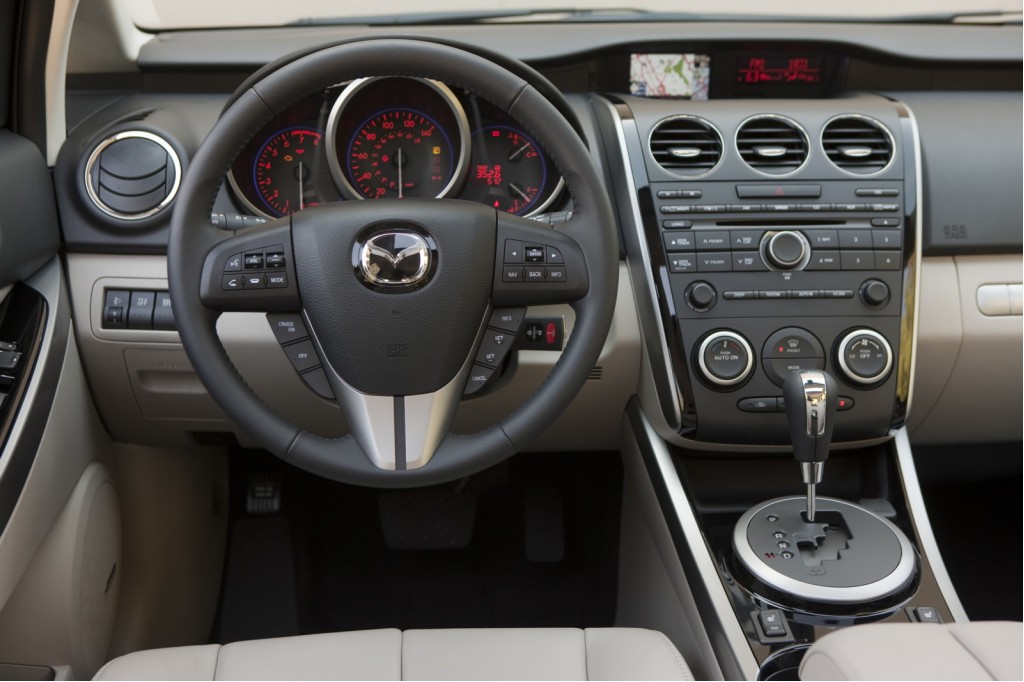
The Mazda CX-7’s meticulously well-crafted cabin is designed to immerse five adults, and their cargo, in meaningful style and comfort. With attention to detail that invites and rewards your closest scrutiny. Take the Grand Touring’s interior, for example. Contrasting the rich, warm contours of its leather-trimmed seats are handsomely textured accent stripes. Elegant, Piano Black cabin accents complete the look. 2011 Mazda CX7 Both Touring and Grand Touring models include these additional refinements: An 8-way power-adjustable driver’s seat with adjustable lumbar support. Heated front seats. A leather-wrapped steering wheel and shift knob. And, of course, leather-trimmed seats. Yet, there is also much to be said about the things that all CX-7 models share.


Don’t let the 2011 Mazda CX-7’s sensuous styling fool you. Beneath its sleek silhouette beats the practical heart of an all-purpose SUV. For example, a quick pull on the handy remote releases in the cargo area, and the Mazda CX-7’s versatile 60/40 split rear seatbacks conveniently fold down nearly doubling available cargo space to a generous 58.6 cu ft. Which allows you to transport everything from outdoor gear and luggage to home electronics and office equipment.* And all without the hassles of removing any headrests. Other equally astute design touches include the center console’s lockable storage compartment and a built-in 12-volt outlet that makes recharging a snap. Plus an array of well-placed cup holders, bottle holders and other storage areas to further enhance cabin utility. So while SUV practicality and versatility are only half the picture, they make CX-7 twice as attractive.  Please remember to properly secure all cargo.

2011Mazda CX-7

Standard Safty Mazda CX-7, passenger safety doesn’t depend upon extra-cost options or upgrades. It comes standard. Which is why every Mazda CX-7 we make includes: Four-wheel ventilated disc brakes. An Anti-lock Brake System with Electronic Brakeforce Distribution and Brake Assist. Dynamic Stability Control. An electronic Traction Control System. Even a Tire-Pressure Monitoring System. Better still, inside the CX-7’s cabin, you’re surrounded by the extra structural reinforcements of Mazda’s “Triple H” construction, front and rear crumple zones, plus a full complement of dual front air bags, front side-impact air bags and front/rear side-impact air curtains* with rollover protection. The impressive result: Mazda CX-7 earned the highest possible rating Five Stars in government frontal and side-impact crash tests.† Equally impressive, every CX-7 model is also available with Active Torque Split All-Wheel Drive to help provide optimum traction and control regardless of changes in weather or road surface. It’s one more way Mazda puts safety engineering and performance on an equally solid footing.

2011 Mazda CX-7

Bland and boring SUVs are now officially obsolete. As are SUVs with road manners as uncivilized as their MSRPs. Because the Mazda CX-7 Sport, our most affordable model, delivers the looks, versatility and available features of vehicles costing thousands more. In fact, the CX-7’s strong,
muscular styling and compelling contours set the stage for a surprising matrix of performance engineering, practical appointments and space optimization. With standard features that include a turbocharged and direct-injected engine. A 6-speed Sport AT automatic transmission.
Sophisticated 4-wheel independent suspension. And power-assisted 4-wheel ventilated disc brakes with ABS and Dynamic Stability Control. Plus interior refinements like a 6-way manually adjustable driver’s seat. A tilt steering wheel with illuminated controls for the audio and cruise-control systems. Air conditioning with dust and pollen filter. An AM/FM/CD audio system. Power windows, mirrors and door locks. Even 60/40 split fold-down rear seatbacks. Thanks to the CX-7 Sport, style, exhilaration and value are no longer mutually exclusive.
Bland and boring SUVs are now officially obsolete. As are SUVs with road manners as uncivilized as their MSRPs. Because the 2011 Mazda CX-7 Sport, our most affordable model, delivers the looks, versatility and available features of vehicles costing thousands more. In fact, the CX-7’s strong,
muscular styling and compelling contours set the stage for a surprising matrix of performance engineering, practical appointments and space optimization. With standard features that include a turbocharged and direct-injected engine. A 6-speed Sport AT automatic transmission. Sophisticated 4-wheel independent suspension. And power-assisted 4-wheel ventilated disc brakes with ABS and Dynamic Stability Control. Plus interior refinements like a 6-way manually adjustable driver’s seat. A tilt steering wheel with illuminated controls for the audio and cruise-control systems. Air conditioning with dust and pollen filter. An AM/FM/CD audio system. Power windows, mirrors and door locks.
Even 60/40 split fold-down rear seatbacks. Thanks to the CX-7 Sport, style, exhilaration and value are no longer mutually exclusive.

2011 Mazda CX-7 Interior

Like sports-sedan-inspired front bucket seats that, as such, are firmly bolstered and readily adjustable. A lockable center console storage bin that’s designed with enough room to hold a purse or laptop. An AM/FM/CD stereo system that includes automatic level control and illuminated, steering-wheel-mounted controls. Versatile 60/40 split rear seatbacks that boast a fold-flat design. Even an expansive, 38.9-inch-long cargo area (rear seatbacks up) that includes a reversible floor panel (carpet/durable composite). But then, at Mazda, quality and details count.

Peer past the stunning 65.6-degree slant of the 2011 Mazda CX-7’s sleek windshield, and you’ll discover an equally unforgettable cockpit. One that’s as cutting-edge as it is refined. And as personally satisfying as it is sophisticated. All thanks to an insightful array of standard features and purposeful options. Add the available Technology Package for example, and your driving experience is instantly enhanced on multiple levels. With the intelligence of a voice command-activated, touch-screen DVD navigation system. The security of an integral rearview camera. And the compelling acoustic capabilities of an in-dash 6-disc CD changer mated to an awesome, 240-watt Bose® 9-speaker Centerpoint® Surround System with AudioPilot®. You’ll even enjoy the elegance, thoughtful design and simplified operation of a “one-touch” power sliding-glass moonroof. Plus the added convenience of a Mazda Advanced Keyless Entry & Start System. Which is why, after just one look at the 2011 MazdaCX-7’s cockpit, other Crossovers simply appear out of style. And out of touch.

ENGINE and DRIVETRAIN CHOICES
- 161-hp, 2.5L engine with 5-speed Sport automatic transmission and front-wheel drive (i trim)
- 244-hp†, 2.3L turbocharged engine with 6-speed Sport automatic transmission and front- or all-wheel drive (s trim)

FUEL EFFICIENCY
- 20/28 mpg (i FWD), - 18/24 mpg (s FWD),- 17/21 mpg (s AWD)

AVAILABLE FEATURES
Available automatic climate control, Bose audio, Bluetooth® hands-free phone and audio capability**, compact navigation system and the perfect combination of car-like handling and SUV utility

Model Series and Price 2011 Mazda CX7

2011 Mazda CX7 i SV Price $21,990. 2011 Mazda CX7 i Sport $22,795. Mazda CX7 s Touring $26,255. 2011 Mazda CX7 i Touring $26,390. 2011 Mazda CX7 s Touring AWD $27,955. 2011 Mazda CX7 s Grand Touring $31,640. 2011 Mazda CX7 s Grand Touring AWD $33,340

Tuesday, April 26, 2011

2011 Mazda Rx8 The Luxury and Excellent High Concept

The 2011 Mazda RX-8 uses the latest generation of Mazda's Renesis twin rotary engine with a combined displacement of 1.3 litres. It doesn't rely on turbo-charging, yet manages to produce 228bhp. Instead of a succession of cylinders and pistons there's a large oval chamber in which a roughly triangular 'rotor' rotates. Where the faces of the triangle pass the spherical sides of the chamber, three separate crescent-shaped spaces are formed. Within these, the stages of the combustion process - induction, compression, ignition, combustion and exhaust - all occur as each pass the inlet ports, twin spark plugs and exhaust ports. There are two of these chambers, each with a nominal capacity o 654cc each. There's a subtly menacing whirring noise, while power delivery is progressive, instantly accessible and builds rapidly in intensity.


2011 Mazda RX8

The Mazda RX-8 was designed as a front mid-engine, rear-wheel drive four-seat four-door coupé. The car has 52:48 front-rear weight distribution, and a low Polar Moment that is achieved by mounting the engine behind the front axle and the fuel tank ahead of the rear axle. The front wheels feature classic independent double wishbone suspension, while the rear are independent multi-link. Weight is trimmed through the use of materials such as aluminium and plastic for several body panels. The rest of the body is steel, save for the plastic front and rear bumpers. The manual gearbox model uses a carbon fiber composite driveshaft to reduce the rotational mass (moment of inertia) connected to the engine. Power is sent to the rear wheels via a Torsen limited slip differential for improved handling. While its not quite in the league as the last Mazda RX-7 in terms of raw performance, the Mazda RX-8 is considered its successor as Mazda's rotary engine sports car. Its layout and clever engineering, along with typical Mazda suspension tuning, have endowed it with excellent driving dynamics which have garnered much praise and numerous awards. It has also proven popular in Japan among car enthusiasts as well as aftermarket equipment manufacturers and professional tuners.


2011 Mazda RX8
The 'Nemesis' model is the 3rd special edition model launched in the UK and is a UK exclusive. It was launched in 2006, although some cars were registered in 2007 due to stock runoff. The ‘Nemesis’ features unique paint colours and interior trim, plus an exclusive accessory package, at a cost that was at the time £330 less than the model on which it is based - when similarly specified. Based on the standard 192ps (141 kW) version of the Mazda RX-8, it included a unique stone leather seat trim interior and came with a five-speed manual transmission. The Nemesis has several other unique exterior and interior features. Two exclusive colours were available, Copper Red Mica and Stormy Blue Mica, each Nemesis also comes with a polished aluminium Rotary crest on the front air dam, polished aluminium side air-outlet trims behind the front wheel arches, special B-pillar trims with a Rotary crest and ‘Nemesis’ badging.

Mazda RX8 Limited Edition Sport Car

Inside these special edition models also featured Nemesis branded luxury carpet mats and Mazda RX-8 branded aluminium door scuff plates. Like other standard 192ps RX-8s, the Nemesis has front fog lights, heated front seats, electrically-operated driver’s seat, climate control air-conditioning, nine-speaker BOSE premium audio system with 6-CD auto-changer, plus a black leather-wrapped steering wheel, gear knob and hand-brake lever. The Nemesis has a top speed of 139 mph and accelerates from 0 to 60 mph in 7.2 seconds. Each Nemesis buyer also qualified for a complimentary Prodrive experience day. Just 350 examples where commissioned, 200 in Copper Red and 150 in Stormy Blue.

2011 Mazda RX8

 Mazda engineers improved the 2011 Mazda RX-8 body rigidity through the addition of structural reinforcements, by adding a trapezoidal strut tower bar and enhancing the local rigidity of the front suspension tower areas. The 2011 Mazda RX-8 is also 90 lbs lighter than the previous (2011-2012) models. Additionally, the rear suspension geometry has been reconfigured for better handling by improving driveshaft rigidity, lowering NVH levels, and improving overall performance. The 09 RX-8 has a different gearing ratio (on manual transmission-equipped cars) that is lowered from 4.444 to 4.777 for improved off-the-line performance. While minimal, these performance changes give the 2011 Mazda RX-8 increased acceleration and performance, as well as even greater responsiveness to the accelerator pedal. Mazda claims that the 09 RX-8 is a significantly faster car than the previous (2011–2012) model car due to the lighter weight, lowered gearing, and improved suspension.


2011 Mazda RX8 Interior

The 2009 Mazda RX-8 also receives design enhancements that are meant to freshen the styling and give the RX-8 a new look, without impairing the basic design theme. Refinements for the 2009 model year include a more aggressive restyled front and rear bumper as well as a new front fascia. The 09 RX-8 also comes with sporty, high-quality finish front and rear headlamps as well as larger exhaust pipes (now measuring 90 mm across). The 2009 Mazda RX-8 also offers a new five-spoke wheel design featuring a symbolic and sporty design reminiscent of the rotary engine, with different arrangements for each wheel size.

New series 2011 Mazda RX8 Price

Sport                   $26,795*
Grand Touring     $32,260*
R3                      $32,290*

BlackCarRacing

Twitter Delicious Facebook Digg Stumbleupon Favorites More